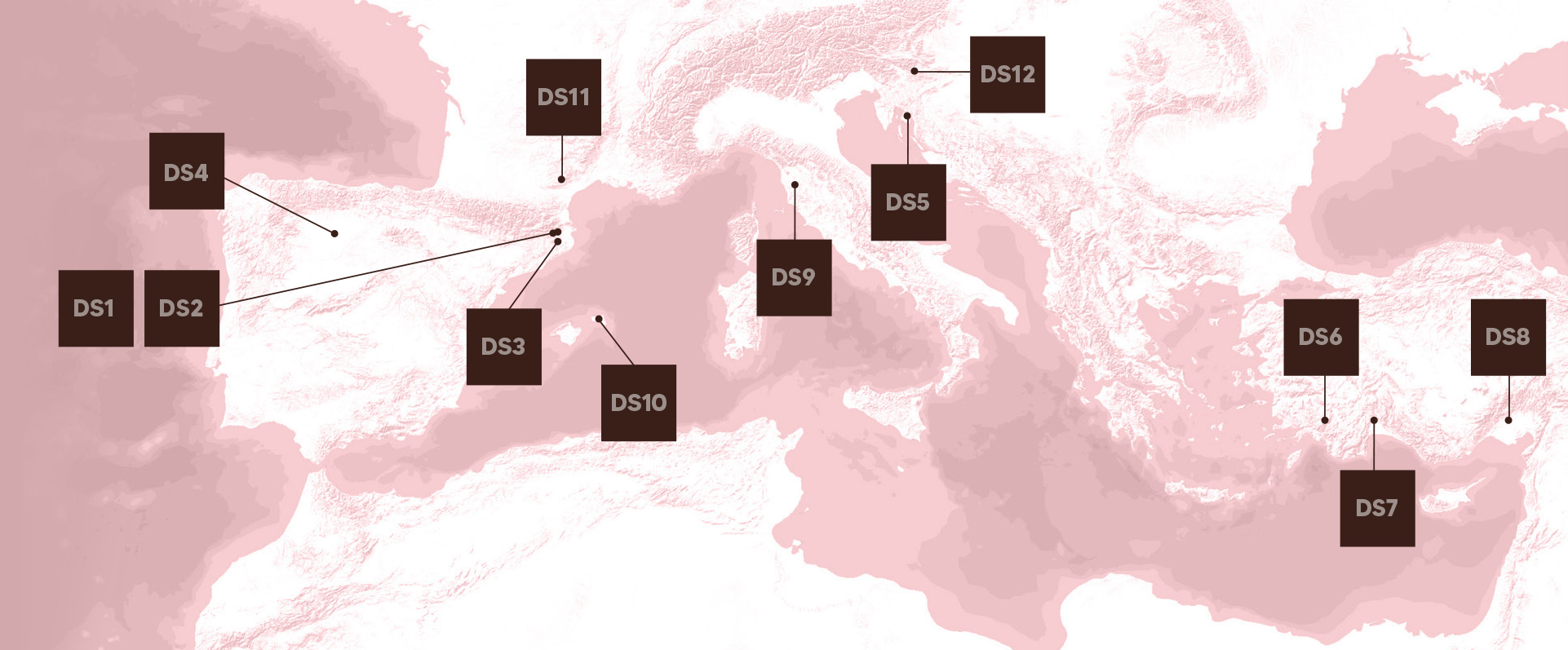
As part of COSMOS implementation, a network of demonstration sites has been established to test and promote innovative agroforestry practices across diverse Mediterranean regions. These sites serve as practical, field-based examples of how integrated land management strategies can be tailored to local contexts. The following summary presents each site, highlighting the agroforestry models developed and the cultivation practices introduced or refined during the project.
Demonstration Site 1 (DS1)
Led by Agrotecnio in Catalonia, Spain, this site focuses on the co-production of pine nuts and truffles using the example of Pinus pinea and Tuber borchii. A key cultural practice tested at this site is weed control without the use of herbicides.
Demonstration Site 2 (DS2)
Also managed by Agrotecnio in Catalonia, Spain, this site explores the co-production of medicinal and aromatic plants (MAPs), specifically thyme and lavender, alongside truffles using Quercus ilex and Tuber melanosporum. The main practices tested include irrigation optimization and fertilization.
Demonstration Site 3 (DS3)
Operated by CTFC in Catalonia, Spain, this site is developing co-production systems for cork and truffles using grafted Quercus suber and Tuber melanosporum. As in DS1, weed control is implemented without the use of herbicides.
Demonstration Site 4 (DS4)
Managed by IDForest in Castilla León, Spain, this site focuses on truffle production based on Quercus ilex and Tuber melanosporum, while also testing co-production with Vitis vinifera. Cultural practices include low water consumption techniques through drip irrigation combined with fertilization (fertirrigation).
Demonstration Site 5 (DS5)
A collaboration between CFRI and RBI in Croatia, this site explores the co-production of truffles and aromatic plants using Quercus species and Tuber aestivum. The team is testing pesticide alternatives and working on improving soil health.
Demonstration Site 6 (DS6)
Located in Muğla, Türkiye, and operated by Ç.Ü and Demirsoy Tarım, this site investigates the co-production of truffles (Quercus ilex + Tuber aestivum), MAPs (Lavandula angustifolia), and honey. Key practices being refined include irrigation optimization, herbicide-free weed management, soil tillage, and pollination techniques.
Demonstration Site 7 (DS7)
Also run by Ç.Ü and Demirsoy Tarım, but in Antalya, Türkiye, this site features Quercus robur and Corylus species seedlings inoculated with truffles and interplanted with lavender. The cultural practices introduced are irrigation optimization, weed management without herbicides, soil tillage, and pollination.
Demonstration Site 8 (DS8)
Based in Adana, Türkiye, and led by Ç.Ü, this site tests the co-production of truffles and MAPs using Quercus ilex and Tuber aestivum. Techniques introduced include irrigation optimization, herbicide-free weed management, and soil tillage.
Demonstration Site 9 (DS9)
UNISI oversees this site in Tuscany, Italy, where the co-production of truffles and MAPs is being tested using Quercus robur and Tuber magnatum. Cultural practices include weed control without herbicides and improving soil health.
Demonstration Site 10 (DS10)
This site, located in Menorca, Spain, and led by CNRS, focuses on truffle production using Quercus pubescens and Tuber melanosporum. Weed control is performed without the use of herbicides.
Demonstration Site 11 (DS11)
Located in Languedoc, France, and also managed by CNRS, this site works on truffle production using Quercus ilex and Tuber melanosporum, in combination with Vitis vinifera. Weed control practices are implemented without herbicides.
Demonstration Site 12 (DS12)
In Slovenia, SFI collaborates with a pair of tourist farms to explore co-production of truffles and fruits using Corylus species and Betula pendula seedlings inoculated with Tuber aestivum or uncinatum, along with fruit and nectar bearing trees in hedgerows. An experimental setup focuses on optimizing both above- and below-ground hedge maintenance as a novel method to enhance product diversification by reviving traditional cultural use of marginal lands.